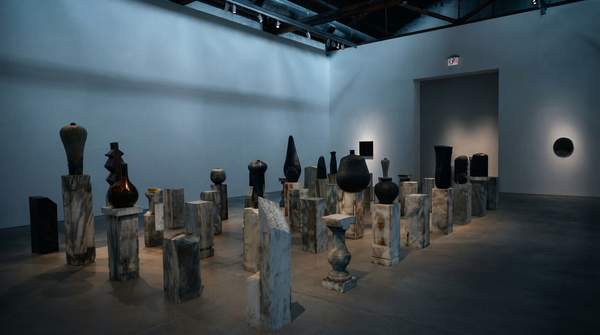
Chicago's art world is quietly reorganizing itself around the neighborhoods it serves. Two announcements made in November 2026 point in the same direction: West Edge Arts, a new arts destination shaped by a resident advisory committee, is scheduled to open in North Lawndale in summer 2027, and Michelle T. Boone, the Poetry Foundation's president and CEO, will retire at the end of 2027 after a tenure that expanded grantmaking and diversified the literary field's leadership. Together they suggest a scene where the decisive cultural action is increasingly local.
Chicago's Evolving Art Scene: A Dual Transformation
Neither announcement is a small one. The Poetry Foundation, based in Chicago, is among the largest funders of poetry organizations nationally; it publishes Poetry magazine and distributes grants to poetry nonprofits, publishers and presses. Boone, who previously served as the city's cultural commissioner, took over the foundation's top role in 2021 and became the first woman and first Black leader of the organization, which began in 2003 with a major gift from philanthropist Ruth Lilly.
West Edge Arts, meanwhile, represents a different kind of institution-building: a planned arts destination on the West Side whose development has been guided since 2025 by a Community Advisory Committee of local residents, artists, and civic and community leaders. Read together, the two developments describe a scene evolving on two fronts at once — where the art gets made, and who decides which art and artists get supported.
West Edge Arts: A Model for Community-Driven Development
West Edge Arts is a case study in how a new institution can be built from the neighborhood outward rather than imported into it. In 2025, the project established its Community Advisory Committee to help inform development and strengthen connections to the West Side. Over the past two years, the committee has offered feedback on artistic concepts, helped shape community events and engagement opportunities, and connected the project with local artists, organizations and businesses.
The engagement has been tangible, not ceremonial. At project events, guests have been entertained by West Side groups including the North Lawndale College Prep Dance Team and the Celestial Ministries Drum Line. The project's stated aims are explicitly local: celebrating the community's history and culture while bringing new visitors, opportunities for local artists and businesses, and continued momentum to the West Side. Bob Faust, the project's senior curatorial advisor and a Chicago artist, designer and cultural producer, put it simply: "This project will be special. It will be inspiring."
Shifting Leadership at the Poetry Foundation: Michelle T. Boone's Legacy
Boone's retirement closes a tenure that reshaped one of the country's major literary funders. Under her leadership, the foundation introduced significant new awards — including the $25,000 Pegasus Award for Service in Poetry in 2023 and, in 2025, the $10,000 Pegasus Poetry Book Prize in partnership with Graywolf Press — and developed its first strategic plan since 2006, launched in 2022 with a grantmaking strategy committing $9 million over three years. That same year, the foundation transitioned from a private operating foundation into a private nonoperating grantmaking foundation.
The scale of the shift is visible in the numbers. The foundation reported $13.8 million in revenue in 2024, with $313 million in total assets, and its grantmaking portfolio expanded with millions in annual arts grants. Newcity's reporting tallied $17 million granted since 2021 to nonprofit literary arts organizations, publishers and presses, describing the organization as having become "a funding powerhouse for the literary arts in the United States."
Boone also changed who is published and honored. She spearheaded a commitment to publishing more diverse voices in Poetry magazine, hired the magazine's first Black editor-in-chief, Adrian Matejka, in 2022, and pushed for the establishment of Chicago's first poet laureate — a position first held by avery r. young, named in 2023, and now held by Mayda del Valle through 2027. "I have had the privilege of working alongside a deeply committed board and talented staff to lead the Poetry Foundation into a new era of amplifying poetry and celebrating poets," Boone said in a statement. Her successor has not been named, and the foundation approaches its 25th anniversary as that search begins.
Comparing Chicago's Arts Models: Centralized vs. Community-Embedded
These developments sit within a landscape where two operational models coexist. Established institutions like the Museum of Contemporary Art Chicago maintain a permanent collection of more than 3,700 works and offer members exclusive access to experiences and events, while the Arts Club of Chicago describes its mission as a forum for conversation between arts lovers and art workers. Platform-based efforts like Gertie cultivate a community of collectors and patrons in Chicago, with curated travel experiences extending that work to destinations from Reykjavík to Marfa, Texas. Community-embedded initiatives operate differently, and the contrast is clearest laid side by side.
Chicago's Evolving Art Scene: A Comparative Framework
The table below categorizes Chicago's arts institutions by their stated missions, locations and engagement strategies, so residents and artists can identify which model fits their goals — whether that means viewing international contemporary work, finding a professional development hub, or joining a neighborhood's cultural decision-making.
| Dimension | Centralized institutions (e.g., MCA Chicago, Arts Club, Gertie) | Community-embedded initiatives (e.g., West Edge Arts, Hyde Park Art Center, The Franklin) |
|---|---|---|
| Model focus | Maintaining permanent collections and offering member experiences; cultivating collectors and patrons; curated travel experiences extending engagement beyond Chicago | Serving as hubs for local artists with exhibitions, classes, professional development and residencies; engaging residents and building community |
| Primary audience | Collectors and patrons in Chicago, members seeking exclusive access to experiences and events | Local residents, neighborhood artists and surrounding communities, inferred from their engagement strategies |
| Geographic locus | Centralized within the city, with programming and travel extending to national and international destinations | Grounded in specific neighborhoods: North Lawndale, Hyde Park, East Garfield Park |
| Leadership and curation | Institutional boards and staff; the Arts Club lists an extensive board guiding its mission | Community advisory committees of residents, artists and civic leaders shaping artistic concepts and programming |
The community-embedded column has real precedents. Hyde Park Art Center has long been a hub for local artists, offering exhibitions, talks, classes, professional development and residency programs, and its exhibition Artists Run Chicago 2.0 celebrated 50 artist-run spaces fueling the city's independent scene. The Franklin, an outdoor venue in East Garfield Park — a primarily Black, working-class neighborhood where low rents have drawn artists — was created, in its founders' telling, as a way for artists to engage residents and build community.
Implications for Local Artists and Residents
For artists, the practical stakes are concrete. West Edge Arts is explicitly designed to bring opportunities to local artists and businesses on the West Side, and its advisory committee structure means neighborhood artists have a documented channel into programming decisions. For the literary field, the Poetry Foundation's expanded grantmaking — $17 million since 2021, plus new awards and a $9 million multi-year grantmaking commitment — represents funding that nonprofit literary organizations, publishers and presses can pursue, with a stated commitment to supporting poetry "in all its diversity and range."
For residents, the shift means cultural programming designed with their input rather than simply near their homes. The West Edge Arts committee model, the Hyde Park Art Center's open-door approach, and The Franklin's neighborhood engagement all point toward institutions that treat proximity as a relationship rather than an address.
Navigating Chicago's Evolving Art Landscape
Local artists and residents should actively seek out and engage with community-embedded arts initiatives and institutions that prioritize diverse voices and neighborhood-level programming. The measurable indicators to watch are increased participation in community advisory committees, attendance at neighborhood-based art events, and applications for grants from foundations with diversified funding priorities — potential outcomes these announcements open up, though not guaranteed ones. The next dated milestones are clear: West Edge Arts opens in North Lawndale in summer 2027, and Boone's retirement takes effect at the end of 2027, with the foundation's leadership search and its 25th anniversary framing whatever comes next.
Sources
- Poetry Foundation President and CEO Michelle T. Boone Announces… — The Poetry Foundation