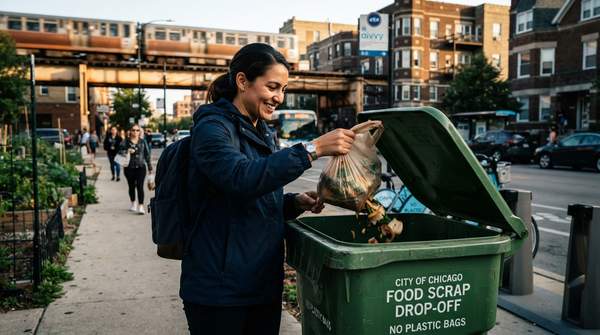
Chicago residents can compost their food scraps for free through the city's Food Scrap Drop-Off Program, and getting started takes three steps: sign up online for a nearby site, collect scraps in a sealed container at home, and empty them into the green carts at your chosen location. The program, launched in October 2023 as the city's first-ever citywide composting initiative, accepts a broad range of food waste — including meat, fish, dairy and bones — while strictly excluding liquids, bags and non-food compostables. Here is how it works, what belongs in the bin, and why the rules matter.
Understanding Chicago's Food Scrap Drop-Off Program
The Food Scrap Drop-Off Program is the City of Chicago's first citywide composting initiative, launched on October 16, 2023, by Mayor Brandon Johnson and the Department of Streets and Sanitation. It began with 15 drop-off locations spread across the city, giving all residents — including those in apartments and multi-unit buildings without private composting services — a free way to divert food waste from landfills.
The city framed the effort as a climate measure from the start. "Diverting food scraps for composting is one of the easiest and most impactful ways for individuals and cities to address the climate crisis," Mayor Johnson said at the launch. The program's core purpose is to keep organic material out of landfills, where it decomposes into methane, and turn it into compost instead.
How to Participate: A Step-by-Step Guide
Participation is designed to be simple and free for any Chicago resident. The process, as described in the program's launch coverage, follows three steps:
- Sign up. Residents complete a sign-up form for the drop-off location nearest to them.
- Collect scraps at home. Store food scraps in a sealed container — the sealed container keeps odors contained and makes transport practical.
- Drop off. Bring the collected material to the green carts at your chosen drop-off site and empty the scraps in.
Because the program is drop-off rather than curbside, there is no pickup schedule to track. Residents simply bring material when their container is full.
Accepted and Prohibited Materials: The 'Yes' and 'No' List
The program's material rules are deliberately narrow: only food scraps are accepted, not the full range of compostable materials. That narrowness is a feature of the initial design, aimed at keeping the list of acceptable items short and easy to understand so residents can follow it correctly.
The "yes" list is broad on the food side. Accepted materials include meat, fish, dairy, bones, coffee grounds, cooked food, fruits, vegetables and grains. The "no" list excludes liquids, compostable packaging, napkins, soiled paper and other compostable non-food materials. Plastic bags — including those labeled compostable — are also prohibited, so scraps should be emptied from any bag into the cart.
Finding Your Nearest Drop-Off Location
Chicago now has 33 food scrap drop-off sites around the city, many of them located at public libraries. The city has added several sites since the program first launched, so if no location is convenient today, a closer one may appear over time.
To find the current list, use the official map on the Chicago Recycles website: search for your address or ZIP code to locate the nearest site. Because locations change as the program expands, checking the official map — rather than relying on a list that may go stale — is the reliable way to find a current drop-off point.
Program Growth and Environmental Impact
The program has grown substantially since its 2023 pilot. On October 15, 2025, officials announced that 13 Chicago Public Library branches would begin serving as drop-off sites through a partnership between the Department of Streets and Sanitation and the library system, bringing the total number of drop-off options to 33. Officials said library locations bring composting "closer to where people live, learn and gather."
The participation numbers reported by officials as of October 2025 show real traction: roughly 7,500 households have signed up, and more than one million pounds of food waste has been diverted from landfills in the program's first two years. The environmental rationale is straightforward. According to the Environmental Protection Agency, food waste accounts for nearly one-quarter of all material landfilled in the United States, contributing to greenhouse gas emissions — methane in particular. Composting offers a different path: as the city's own program materials explain, composting is a controlled, aerobic (oxygen-using) process in which microorganisms convert organic matter into compost, a dark, crumbly material used to build healthy soil. The finished compost from the program is sold as a soil amendment.
Chicago Food Scrap Drop-Off Program: Your Quick Start Checklist
Use this checklist to prepare your scraps correctly and avoid the contamination that the program's rules are designed to prevent. Each row synthesizes the official program rules and launch reporting into a quick yes/no reference.
| Step or Category | What To Do / What Applies |
|---|---|
| Step 1: Sign up | Complete the sign-up form for the drop-off location nearest you. |
| Step 2: Collect | Store food scraps in a sealed container at home until you're ready to drop off. |
| Step 3: Drop off | Empty your scraps into the green carts at your chosen site. |
| Accepted (Yes) | Meat, fish, dairy, bones, coffee grounds, cooked food, fruits, vegetables, grains. |
| Prohibited (No) | Liquids, plastic bags (including compostable bags), compostable packaging, napkins, soiled paper, other non-food compostables. |
| Find a site | Use the official Chicago Recycles map; search by address or ZIP code. 33 sites as of October 2025, many at public libraries. |
Why Specific Items Are Excluded
The exclusions can seem counterintuitive — why would a composting program reject compostable bags or napkins? The answer lies in contamination risk. By keeping the accepted list limited to food scraps, the city reduces the potential for contamination, which protects the quality of the finished compost. Liquids, packaging and soiled paper are harder to sort and verify at the cart, and a load of contaminated material undermines the aerobic process that turns scraps into usable soil amendment.
Advocates have noted the trade-off: the narrow list means many compostable materials still go to landfills. At launch, U.S. PIRG Education Fund observed that for the program to reach its full potential, the city should expand the accepted range once the program is more established, and that substantial expansion would be needed to achieve a vision of zero food waste sent to landfills from Chicago. The growth from 15 to 33 sites suggests the city is moving in that direction, though the accepted-materials list remains food-scraps-only.
Your Role in Chicago's Composting Future
The decision for residents is simple: participate in the Chicago Food Scrap Drop-Off Program by collecting accepted food scraps in a sealed container and using the official map to find a convenient drop-off location. Participation is free, the accepted list is short enough to memorize, and every pound of scraps diverted is a pound kept out of a landfill's methane-producing decomposition.
To track the program's trajectory, monitor the official Chicago Recycles website for updates on new drop-off locations or program expansions. With 33 sites as of October 2025 and a stated interest from officials in making composting more convenient, the map is the measurable indicator of what comes next — and a new site near you is the concrete signal that the program's growth is continuing.
Sources
- Food Scrap Drop-Off — Chicago
- Chicago Launches Household Food Scraps Drop-off Program — BioCycle
- Chicago launches food scraps drop-off program — U.S. PIRG Education Fund
- Chicago Expands Food Scrap Compost Drop-Off Program to 13 Public Libraries — WTTW News