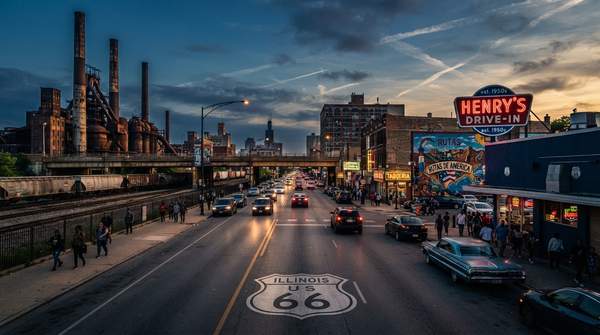
Route 66 begins in downtown Chicago, but the highway's most interesting city stories unfold west of the Loop. Three neighborhoods along the route—North Lawndale, Little Village, and the area around Douglass Park—each carry the old road differently: one as an industrial transport artery, one as a community thoroughfare, and one as a park the highway literally cut through. This guide compares all three so you can match a visit to your own interests, whether that's manufacturing history, a bustling Mexican-American commercial corridor, or public art in historic green space.
Exploring Chicago's Route 66 Neighborhoods: A Comparative Guide
The legendary highway starts on Michigan Avenue, just outside the Art Institute of Chicago, before cutting through some of the city's most historic neighborhoods, including North Lawndale and Little Village, as the official Chicago tourism office describes in its neighborhood guide. Along the way, the route passes local sights, under-the-radar history, and some of the city's best restaurants.
What makes these three areas worth comparing is that Route 66—largely following Ogden Avenue on the West Side—touched each of them in a distinct way. In North Lawndale, the road supported wartime factory logistics. In Little Village, it runs alongside a commercial corridor that later became a cultural hub for Mexican-American residents. At Douglass Park, the highway bisected the parkland itself, reshaping its layout for motorists. Those differences are the basis for choosing between them.
One note on scope: this guide covers only these three neighborhoods, not the downtown starting points, and it isn't a turn-by-turn driving itinerary. Businesses mentioned are illustrative examples, not a complete directory.
North Lawndale: Industrial Heritage and Community Revitalization
North Lawndale's Route 66 story is anchored in manufacturing. Hawthorne Works, once a hallmark of American manufacturing, began as a few dozen buildings in the early 1900s in nearby Cicero and grew into one of Chicago's largest industrial employers. During World War II, the plant produced flight trainers, submarine detectors, mine fuses, and radios for planes, tanks, and artillery—and the nearby Route 66 served as a valuable path to transport that wartime equipment, according to Choose Chicago's account of the neighborhood.
Visitors can still connect with that past at the Hawthorne Works Museum, where the last remaining water tower structure stands. The industrial landscape has changed considerably since the highway's heyday; the tourism office notes that many automotive businesses along the former route closed as fewer travelers drove it, and the buildings they left behind are now occupied by a handful of mom-and-pop car parts dealers and repair shops, many of which celebrate their Route 66 roots.
The neighborhood's modern identity is community-driven. The Lawndale Pop-Up Spot is a community museum featuring exhibitions by and for North Lawndale residents, including work tied to the highway's history. In 2026, the creative studio Jones Corner Store released Elvin Explores North Lawndale on Route 66, a children's book marking the highway's centennial. "We invite the city—and the world!—to experience a slice of Route 66 in Chicago through the perspectives of its residents," said Jay Simon, co-founder of Jones Corner Store, in a statement marking the anniversary. Choose North Lawndale if industrial history and grassroots arts programming appeal to you more than polished tourist corridors.