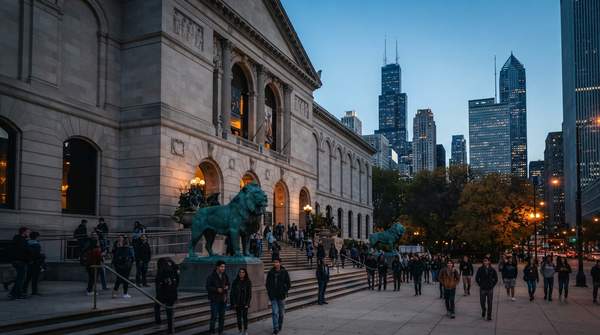
The School of the Art Institute of Chicago began in 1866 as the Chicago Academy of Design, a school founded by artists for artists, and was reorganized and renamed in 1882 as The Art Institute of Chicago to signal a dual mission: teaching art and collecting it. That single decision, driven largely by banker Charles L. Hutchinson, fused a school and a museum into one institution and set the pattern Chicago residents still experience today on Michigan Avenue.
The Genesis: Chicago Academy of Design (1866)
According to the school's own historical timeline, the story starts with a practical impulse: a group of Chicago artists decided to form a school of art in the city, with its own gallery dedicated to the education of its students. That founding principle—artists teaching artists, with a gallery attached to the classroom—was present from day one. The gallery was never an afterthought; it was built into the school's founding logic as a teaching tool.
Just two years later, in 1868, the young academy launched what became its Visiting Artists Program. Widely cited as one of the school's oldest public programs, it brought outside artists, and later designers, scholars, curators and critics, into direct contact with students and the public. The program was later formalized in 1951 through Flora Mayer Witkowsky's endowment of a supporting fund, but its 1868 launch shows how early the institution committed itself to an education enriched by exposure to working practitioners.