Chicago's public schools are governed right now by a hybrid body: 11 members appointed by the mayor and 10 members elected by voters, for a total of 21. That arrangement is temporary — the board is scheduled to become fully elected in 2027. In the meantime, this board holds enormous power. It approves a roughly $10 billion annual budget, levies about half of all property taxes in Chicago, and sets policy for a district serving some 316,000 students. And it runs on rules that any resident can learn and use, whether they want to quietly follow the decisions or stand at the podium and speak.
Understanding the Chicago Board of Education's Hybrid Structure
The board reached its current shape in stages. For decades, mayors alone appointed its members. Chicago elected its first 10 board members on November 5, 2024, and those members were joined by 11 mayoral appointees, growing the body to 21 people. The Chicago Board of Education describes the present arrangement as a hybrid governing body with 11 mayor-appointed members — including the board president — and 10 elected members who represent individual districts.
This hybrid period is deliberately short. The board itself notes it will transition to a fully elected governing model in 2027, and until then each current member serves a two-year term on a volunteer basis. Kids First Chicago, an organization tracking the transition, reports that on November 3, 2026, voters were set to elect all 21 seats, including the president. For residents, the practical upshot is that engagement habits built now — attending, commenting, contacting your representative — will carry over directly to the fully elected board.
Key Responsibilities and Financial Powers
What does this body actually do? Chicago Public Schools assigns it broad oversight of the district. Kids First Chicago, citing the Illinois Association of School Boards, describes the essential job: a school board "establishes direction, goals, and priorities for a school district and determines policy, budget, leadership, and administration." The board hires and evaluates the Superintendent or CEO who runs day-to-day operations, while implementation belongs to the district's management team.
The financial dimension is where the board's reach is most visible. Borderless Magazine, reporting with Chalkbeat Chicago, notes the board has the power to raise local property taxes and decides how local revenue plus state and federal funding streams are allocated to schools. Kids First Chicago puts the stakes in numbers: the board approves a roughly $10 billion annual budget and levies approximately half of all property taxes in Chicago, which it calls one of the most significant fiscal decision-making bodies in Illinois. Its decisions ultimately touch 316,000 students and 46,000 employees.
How to Observe Board Meetings
The simplest form of engagement costs nothing but attention. The board posts upcoming meetings on its website, along with a planning calendar, and the Board Office releases meeting agendas in advance of each session. Meetings are held at the board's offices at 42 West Madison Street in Chicago, and the Board Office registers attendees as well as speakers.
Observation doesn't end when the meeting does. CPS publishes past board actions as PDFs arranged by board report number in the order they were presented, along with videos of the meetings, written proceedings, presentations by senior leadership, and written comments where applicable. The Board Office records meeting proceedings and logs board actions. For anyone trying to understand how a particular decision was made, this archive — paired with the advance agenda — is the paper trail.
Speaking at Board Meetings: Rules and Registration
Addressing the board in person is a formal, rule-governed process. The Board Office is responsible for registering speakers before meetings, and its published guidelines spell out the mechanics of public participation. Registration opens ahead of each meeting, as the board's website notes for its scheduled sessions.
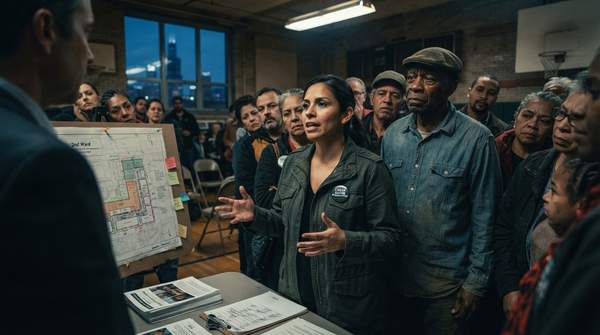
The rules are specific. To comply with the Chicago Municipal Code, which requires that exits, aisles, and passageways stay clear for safe evacuation, a maximum of 10 people may stand with a speaker — five on each side of the podium — and they must remain within designated floor markings along the glass partition. All public presentations must be limited to issues of concern before the board or related to Chicago Public Schools. Speakers who follow these guidelines get the floor; those planning remarks should frame them around district business to stay within the rules.
Submitting Public Comments on Proposed Policies
Not every form of influence requires a trip downtown. CPS states plainly that the board "is committed to listening and reflecting on public comments regarding proposed policies or rule changes," and invites residents to learn about upcoming proposals and submit comments through the district's channels. Both existing board policies and board rules are indexed in searchable public databases, so residents can read the current text before weighing in on a proposed change.
This written route matters because it reaches the board during a policy's formative stage, before a vote. The Board Office describes strengthening transparency of CPS policies and increasing public access and engagement with board members as core parts of its mission — which is why the comment mechanism exists alongside the more visible public-speaking option. Checking the proposals page regularly is the way to catch a window for input.
Connecting with Your Board Member
Every elected board member represents a specific district, and CPS offers a lookup tool: residents enter their address to find their Chicago Board of Education representative. Beyond identifying who speaks for your area, the tool links to the board's website, where residents can view upcoming meetings and schedule time to connect with their representative.
The most direct format is board member office hours. The Board Office hosts these sessions specifically to allow the public to speak with board members about important issues — a lower-stakes, more conversational setting than a formal meeting. For localized concerns that don't belong on a meeting agenda, office hours and a scheduled conversation with your district representative are the designated path.
Your Guide to Engaging with the Chicago Board of Education
Once you know what you want to accomplish, the right channel follows from it. The matrix below maps the most common resident goals to the official procedure, the key rules, and where to start.
| Your Goal | Method of Engagement | Key Steps & Rules | Official Resource |
|---|---|---|---|
| Follow decisions that affect your school or neighborhood | Observe a board meeting, in person or via recording | Check the agenda the Board Office releases before each meeting; consult the planning calendar; review past actions, videos, and written comments afterward | Board website meetings and actions pages |
| Voice your opinion on an issue of concern | Speak during a board meeting | Register as a speaker with the Board Office before the meeting; keep remarks limited to issues before the board or related to CPS; no more than 10 people may stand with you, within the marked floor areas | Guidelines for Public Participation at Board meetings |
| Influence a policy or rule before it is final | Submit a written public comment | Track upcoming proposals, read the current policy in the searchable database, and submit your comment through the district's public comment channel | CPS proposed policy and public comment page |
| Raise a local or district-level concern | Attend board member office hours or schedule a conversation | Use the address lookup to identify your representative; view upcoming meetings; schedule time to connect through the board's website | CPS board member map and Board Office office hours |
The framework works because each goal points to one accountable channel: the Board Office registers speakers and attendees, administers meetings, and hosts office hours, while CPS maintains the policy databases and the comment mechanism. No single page collects all of it, but no step requires more than one.
Empowering Your Voice: Next Steps for Engagement
To engage effectively, identify your goal first — observe, speak, or comment — then follow the corresponding official procedure and use the resources above rather than guessing at the process. Your measurable proof of engagement is concrete: successful registration for public participation, submission of a public comment, or attendance at a board meeting or office hours. And keep November 3, 2026 in mind: that election fills all 21 seats and completes the shift to a fully elected board in 2027, so the representatives you contact and the comment windows you use will soon be the ones voters chose.
Sources
- Chicago's Transition to an Elected School Board — Kids First Chicago
- Board Bios - Chicago Board of Education — CPSBOE
- Chicago Board of Education — CPS
- Chicago Board of Education 101 — Borderless Magazine NFP
- Board Office — CPS
- Guidelines for Public Participation at Meetings of the Chicago Board of Education - Chicago Board of Education — CPSBOE
- Find Your CPS Board Member Representative