Chicago residents who want to shape their city's decisions have several official channels available year-round, and the right one depends on the goal. A broken street or a desired neighborhood improvement runs through your alderperson's office and, in many wards, participatory budgeting. City-wide policy questions lead to City Council meetings and civic organizations that monitor them. When the goal is information itself, the Freedom of Information Act is the tool. Here is how each channel works and how to pick the right first step.
Understanding Chicago's Civic Engagement Landscape
Chicago's city government combines a central legislative body with fifty ward-level offices, each with its own discretionary resources. The City Council passes ordinances and oversees city departments, while each alderperson represents one ward and controls a dedicated infrastructure budget. That structure matters for residents because it means some goals are best pursued at the ward level and others at the city-wide level.
The Better Government Association, a Chicago-based government-transparency organization, runs civic education programming that walks residents through the main levers of influence: Chicago government structure, City Council meetings, public comment, filing a FOIA request, introducing legislation, and working with your alderperson. Its programming frames these as the practical tools a resident needs to be heard by government officials, rather than one-off events. This guide covers those official channels; it does not address grassroots organizing, protests, or state and federal engagement.
Direct Channels for Influencing Policy and Local Issues
Working with your alderperson. The ward office is the entry point for neighborhood concerns, particularly infrastructure. Each alderperson receives $1.5 million annually in "menu" money for ward infrastructure improvements — one of the few funding sources available to alderpeople for repaving streets, resurfacing alleys, and making critical improvements, as the 26th and 46th ward offices both describe. Contacting your ward office to raise a concern or propose a project is the most direct route for local physical improvements.
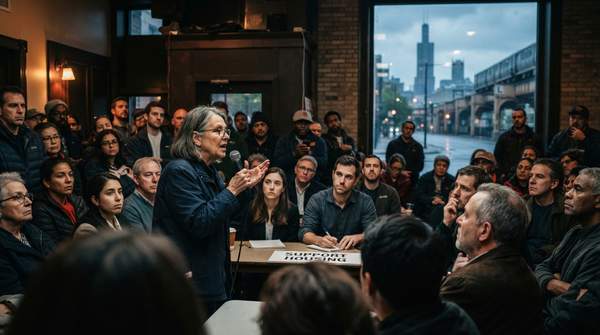
City Council meetings and public comment. For city-wide policy, City Council meetings are where ordinances are debated and passed, and public comment is the mechanism the BGA identifies for residents to address officials directly. Residents can also simply observe: the League of Women Voters Chicago, a volunteer-run civic organization, recruits volunteers to "observe and analyze the workings of Chicago's City Council" as part of its City Government advocacy work. Attending in person or watching remotely is a low-commitment way to learn how decisions actually get made before attempting to influence one.
FOIA requests. When the goal is transparency or obtaining specific public records, the Freedom of Information Act allows residents to formally request documents from government agencies. The BGA treats FOIA as one of its core civic tools and offers training on the process. This article does not provide legal advice on filing requests, but the first step is identifying the agency that holds the records you want and submitting a formal request to it.
Deeper Engagement: Participatory Budgeting
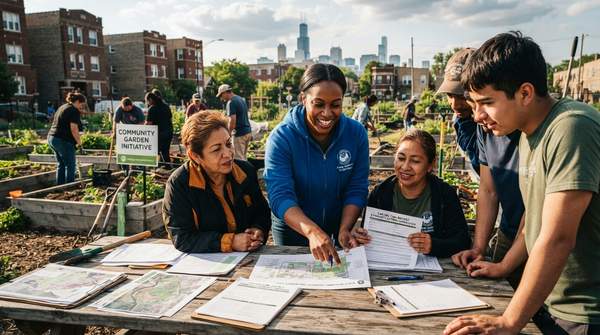
Participatory budgeting (PB) lets community members directly decide how a portion of a public budget is spent, and several Chicago wards run PB processes using their menu money. In the 26th Ward, Alderperson Jessie Fuentes gives residents the power to decide how $500,000 is spent on neighborhood improvements — fixing specific curbs, resurfacing streets, or installing art murals. The ward notes that PB does not cover routine repairs like pothole filling, graffiti removal, or new garbage carts, which go through normal ward services.
In the 46th Ward, Alderwoman Angela Clay asks neighbors to decide how to spend $1 million on neighborhood upgrades. Her office gathered feedback over the spring and summer through block clubs, local school councils, and direct outreach, then collected project ideas against published criteria. The scale of the resident-controlled portion varies by ward, but the model is the same: residents propose, develop, and vote on real infrastructure spending.
The 33rd Ward, represented by Alderwoman Rossana Rodriguez, publishes a five-phase timeline that shows what sustained participation looks like. From March through September, neighbors brainstorm ideas and volunteers are recruited. From September through December, volunteer committee members turn ideas into feasible projects and present them at open expositions. Voting runs January through February, and any resident can vote regardless of immigration status as long as they are age 13 or older. The aldermanic office then works with city agencies to schedule construction according to the vote. Joining at the idea-collection or project-development phase is the deepest way to participate, since volunteers shape what ends up on the ballot.
Joining City Committees and Volunteer Programs
For residents who want ongoing involvement rather than a single campaign, two paths stand out. The first is joining a ward's participatory budgeting committee, where volunteers do the monthslong work of converting raw ideas into fundable projects — a real role in policy development, not just a vote.
The second is structured civic volunteering. The League of Women Voters Chicago describes itself as volunteer-run and offers roles for people who "like to work a crowd or work behind the scenes," whether they have an hour a week or an hour a month. Its City Government volunteer track focuses on observing and analyzing City Council, which builds institutional knowledge that helps members track issues over time. The organization notes that many volunteer opportunities are only available to members, so joining is a prerequisite for those roles. Volunteering with a civic group also provides something individual action cannot: a standing structure for monitoring what the government does between elections.
Choosing Your Path to Civic Impact
The framework below matches common resident goals to the channel designed to handle that type of input, so a general desire to "get involved" becomes a concrete first step.
| Your goal | Recommended channel | What it involves |
|---|---|---|
| Fix a specific neighborhood issue (infrastructure, streets, alleys) | Contact your alderperson's office | Raising the concern with your ward office; alderpersons control $1.5 million in annual menu funds for infrastructure improvements |
| Directly decide how ward money is spent | Participatory budgeting, if your ward runs it | Submitting ideas, volunteering on the PB committee to develop projects, and voting; the 26th Ward allocates $500,000 and the 46th Ward $1 million to resident decisions; routine repairs are excluded |
| Influence city-wide policy | City Council meetings and public comment | Attending in person or virtually to follow debates, and using the public comment process the BGA identifies as a core tool for being heard |
| Monitor government actions over time | Civic observation with a group like the League of Women Voters Chicago | Volunteering to observe and analyze City Council; some roles require membership |
| Obtain specific public records | File a FOIA request | Submitting a formal records request to the agency that holds the documents; the BGA offers FOIA training |
The pattern across the matrix: physical neighborhood problems go to the ward office, spending decisions go to PB where available, policy debates go to City Council, and information goes to FOIA. If your ward does not run PB, the ward office is still the place to ask for it — alderpersons choose whether to open their menu money to resident decisions, as the 26th, 33rd, and 46th wards have done.
Taking the First Step: Your Role in Chicago's Future
Chicago residents can effectively influence local government by selecting the appropriate official channel for their specific civic goal and actively participating in the outlined processes. None of these channels guarantees a particular outcome — a FOIA request may take time, a public comment may not change a vote, and a PB proposal may not win funding — but each is a real, documented mechanism for input.
The measurable indicators of this engagement are concrete: increased resident participation in ward-level participatory budgeting votes, attendance at City Council meetings, and inquiries to alderpersons' offices. A practical starting sequence is to identify your ward and alderperson, check whether your ward runs PB and when its next idea-collection phase opens (the 33rd Ward's cycle begins in March), and mark the next City Council meeting on your calendar to observe it — with a FOIA request ready if the records you need are not already public.
Sources
- The Informed Chicagoan: How to have your voice heard by Chicago’s government officials — Better Government Association
- Participatory Budgeting — 26th Ward
- VOLUNTEER — League of Women Voters Chicago
- Participatory Budgeting — Alderwoman Angela Clay - 46th Ward
- Participatory Budgeting – Rossana Rodriguez — 33rdward